Bartram exhibit visits library
BY KATHY PICKENS
The Greenville Standard
William Bartram and Alabama: A Traveling Exhibit opened at the Greenville Butler-County Public Library (GBCPL) on July 9. The exhibit was brought in at the request of the Butler County Historical and Genealogical Society (BCHGS).
Bartram, a Quaker, self-taught artist, and son of a renowned botanist, was funded by an English patron to search for new plants for English gardens. He set out from Philadelphia in March of 1773 on an expedition to the southern colonies and traveled roughly 2400 miles through the region.
“Bartram traveling through Butler County is one of my favorite parts of our history,” said BCHGS president Pamala Nolan. “When I heard about the exhibit, I contacted Dr. Mark Wilson at Auburn to see about it coming to Greenville. Then I spoke with Kevin (Pearcy) who was completely on board. In a bit of serendipity, the month of July was available which was so perfect because in July 1775 Bartram was in the land that would become Butler County, marking 251 years ago exactly.”
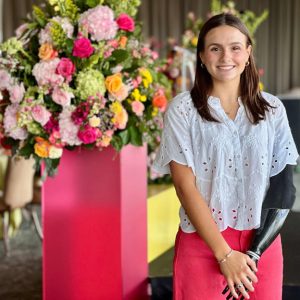
GBCPL Director Pearcy welcomed the numerous attendees to the opening after which Nolan thanked the hospitality committee for their work in preparing the reception and Jan Newton for her vision in creating the amazing diorama-inspired tablescape. Nolan then introduced local author, artist, historian, and genealogist Annie Crenshaw who spun a delightful tale of her personal involvement with the Bartram Trail as a young adult.
Crenshaw’s love of history comes from her mother Myra Ware Crenshaw who was a charter member of BCHGS.
To celebrate the Bicentennial in 1976, Gov. George Wallace began an initiative in the southern states to document the Bartram Trail. M. Crenshaw and Dorothy Parrish, along with others, became immersed in this project, culminating with M. Crenshaw drawing the first map of the Butler County section of the Bartram Trail and with our county to be the first in Alabama marked along the trail.
Parrish’s writings from time indicate that 28 of the 30 miles of the trail that go through Butler County are along highways, which were most likely Native American trails that became the Old Federal Road.
On October 24, 1976, when the portion of Bartram’s Trail in Butler County was marked and dedicated by BCHGS’s early leaders, Gov. Wallace was a special guest at the ceremony held at Sherling Lake Park.
In 2004 BCHGS erected a historical marker that was damaged and lost during the Hurricane Ivan cleanup and later replaced in 2006. This marker is located near the entrance to Cambrian Ridge Golf Course.
In his travels, Bartram crossed over from Georgia into Alabama in July 1775 and visited several Creek towns and Mobile before passing through what is now Butler County. Bartram recorded that the party passed through “a remarkable grove of Dog wood trees, which continued nine or ten miles unalterable, except here and there by a towering Magnolia grandiflora.” This information along with a beautiful rendering of Bartram‘s original dogwood sketch are included on one of the exhibit panels.
Crenshaw added that the area where Bartram cataloged the dogwoods was at one time called Dogwood Flat and later became known as Pine Flat. Part of this community is still evident at the lovely, historic Pine Flat Methodist Church and adjacent cemetery.
The display, which will be on view at the library throughout July, features eight vertical exhibit panels detailing the travels of Bartram and a one hour video documentary that focuses on how six modern southern artists, scientists, or anthropologists have been inspired by Bartram’s work.
The BCHGS invites all to the July Quarterly meeting featuring Alabama Humanities Alliance Road Scholar Mike Bunn who will discuss his book, The Forgotten Story of the Gulf South During America’s Revolutionary Era.
Bunn refers to portions of what are now the states of Alabama, Florida, Louisiana, and Mississippi as the “Forgotten Fourteenth Colony” of America’s Revolutionary era.
The event will be at 2 p.m. on Sunday, July 26, at the First Methodist Church Fellowship Hall.